
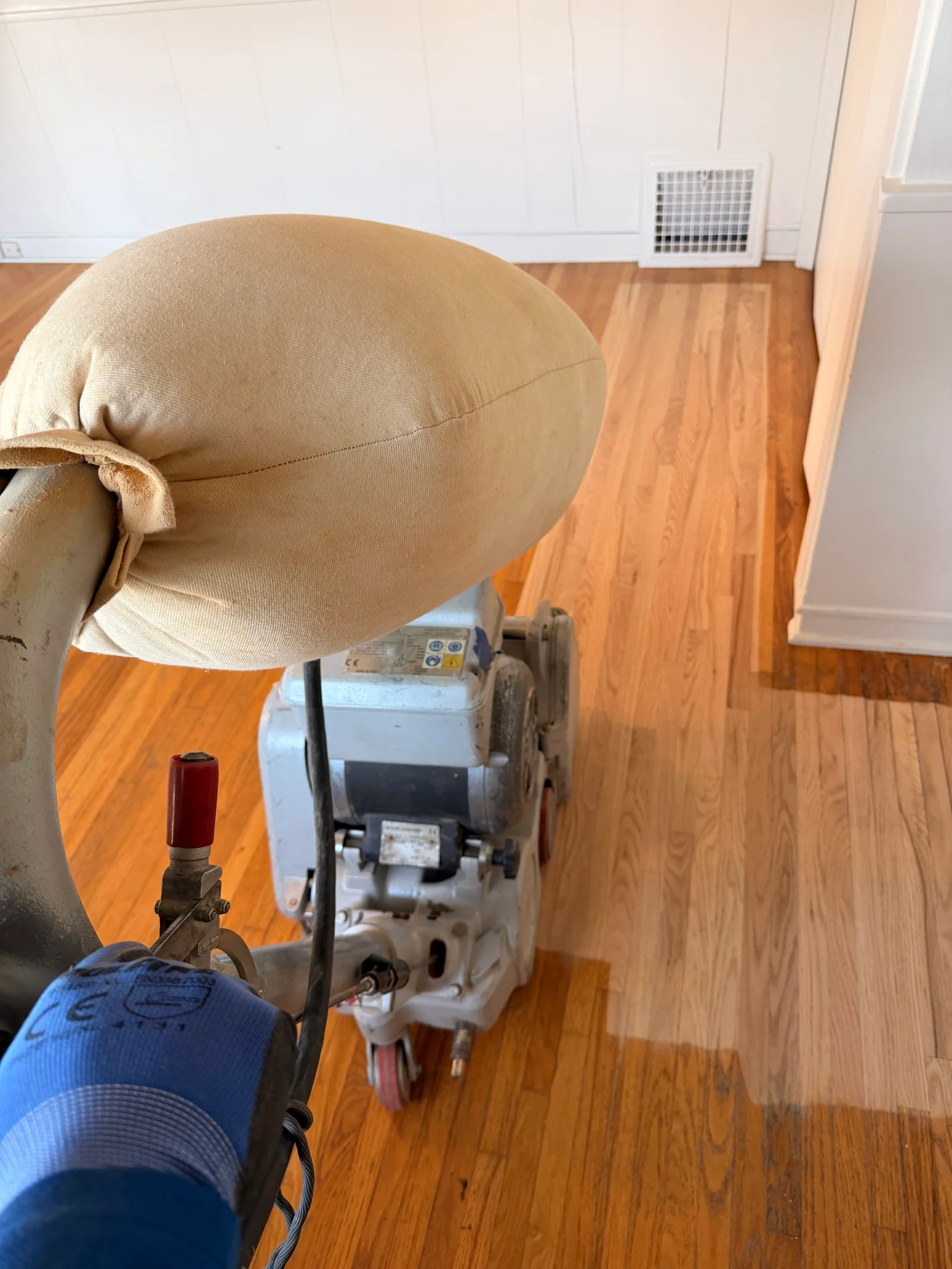
Homeowners ask us two questions about refinishing before they ask about price. How bad is the dust, and do we have to move out.
Both have real answers, and the second one depends far more on the layout of your house than on the job itself. Here is what a refinish actually does to a household, day by day.
The dust question, answered honestly
Sanding a wood floor produces a very large volume of extremely fine dust. There is no version of this job that produces none.
What modern equipment does is capture the overwhelming majority of it at the source, through machines connected to vacuum containment rather than to a bag. The difference between that and older equipment is not marginal. It is the difference between a job you can live alongside and one that puts a film on every surface in the house for a month.
What still helps: sealing doorways to rooms not being worked on, closing and covering HVAC returns and supplies in the work area, taking soft furnishings and open shelving out of adjacent rooms, and accepting that a final wipe-down of horizontal surfaces afterwards is part of the project rather than a sign something went wrong.
Anyone in the house with asthma or a dust sensitivity should plan to be elsewhere on sanding days regardless of the containment. That is a reasonable precaution, not an admission that the equipment does not work.
The odour question depends on the finish
Two broad families of finish, and they behave very differently while curing.
Water-based finishes have far lower odour, dry fast, and allow the household back into the space sooner. They dry close to clear, so a natural oak floor stays lighter and cooler in tone rather than ambering.
Oil-modified finishes have a strong solvent odour that persists for days rather than hours, and they cure more slowly. They also amber over time, which is a warm, traditional look plenty of people specifically want, particularly on older floors.
If anyone in the household is pregnant, elderly, sensitive to solvents, or if there are pets in small enclosed spaces, that is a conversation to have before choosing the finish rather than after.
Dry is not cured, and this is where projects go wrong
The single most misunderstood part of a refinish. A finish becomes dry to the touch, then walkable, then cured, and those are three separate milestones spread across a much longer period than most people expect.
Walking on a floor in socks is permitted well before furniture is. Putting a heavy piece back too early leaves impressions in a finish that has not hardened. Laying an area rug over a curing floor traps solvent, prevents the finish hardening properly underneath, and can permanently mark the floor in the shape of the rug.
The rug is the mistake we see most often, because by that point the floor looks completely finished and the homeowner is tired of living around it. Ask for the specific cure schedule for the specific product going on your floor, and then wait the full time. It is the cheapest thing you will do on the whole project.
A realistic sequence
Every job differs, but the shape is consistent.
- Everything comes off the floor, including rugs, curtains that touch the floor and anything on low shelves nearby
- Containment goes up and HVAC is sealed in the work area
- Sanding, in successive grits from coarse to fine, then edging by hand where machines cannot reach
- Vacuum and tack, then stain if the floor is being colored, with drying time before anything goes over it
- Finish coats, with drying time between each
- Walkable in socks, then eventually furniture, then eventually rugs
The working days are the short part. The waiting is the part that determines whether you can stay.
Staying versus leaving
It comes down to whether the finished areas cut you off from anything you need.
Refinishing an upstairs while the kitchen, a bathroom and a way in and out stay accessible is manageable for most households. Refinishing the main level of an open-plan home, where the only route from the door to the kitchen crosses the work, generally is not.
The specific things to check before deciding: is there a bathroom you can reach without crossing the floor, is there a way in and out, where will the dog go, and where will people sleep. Refinishing a house in phases costs a little more in mobilization and is often the right call for a family that cannot leave.
Pets are the practical constraint people underestimate. A dog crossing a curing floor leaves prints that are in the finish permanently, and a cat that gets into a sealed room will find the one place it should not be.
Sequencing with other work
If painting is happening too, paint first and refinish after. Sanding a floor next to fresh paint is fine; splashing paint on a new finish is not, and touching up trim afterwards is far easier than repairing a floor.
If a kitchen or bath is being remodeled, the floor goes in near the end, after cabinetry and before the final trim. Getting that order wrong is one of the more expensive mistakes in a whole-house project.
Where the floor is being replaced rather than refinished, the sequence differs again, and our post on what to expect from an installation covers it.
Winter refinishing in Wisconsin
Refinishing in a Coulee Region winter is entirely normal and there are two things worth knowing.
Ventilation is harder, because the windows that would carry odour away are also the windows keeping the house warm. That makes a low-odour water-based finish a more comfortable choice in January than in July.
And the indoor air is dry, which is when boards are at their most contracted and seasonal gaps are widest. A floor refinished at the driest point of the year will close up in summer, and that is normal rather than a problem. Our post on flooring in Wisconsin winters covers the movement, and running a humidifier through the heating season helps the floor more than any product does.
The smaller job you might be able to have instead
Before committing to all of the above, it is worth establishing that you need a full sanding at all.
Put a few drops of water on the worst traffic path and wait ten minutes. If it beads and sits there, the finish is intact and a recoat may be all the floor needs. A recoat abrades the existing finish and lays a fresh coat over it: one day rather than a week, a fraction of the dust, and no wood removed.
Our guide to refinishing versus recoating covers how to tell which one you are looking at. If it turns out to be the smaller job, everything on this page gets much easier.
We refinish floors across La Crosse, Onalaska, Holmen and the wider region, and we will plan the phasing around your household rather than around our schedule. See the refinishing service, or book a free in-home estimate and we will run the water test with you.