
Ask three coating companies in this region what they install and you will hear epoxy from one, polyaspartic from another, and a third telling you the other two are wrong. It sounds like a product argument. It mostly is not.
A concrete coating is a system of layers, and epoxy and polyaspartic are two different materials that do two different jobs within it. Understanding which layer is which is what lets you compare quotes that describe themselves very differently.
What a real system looks like
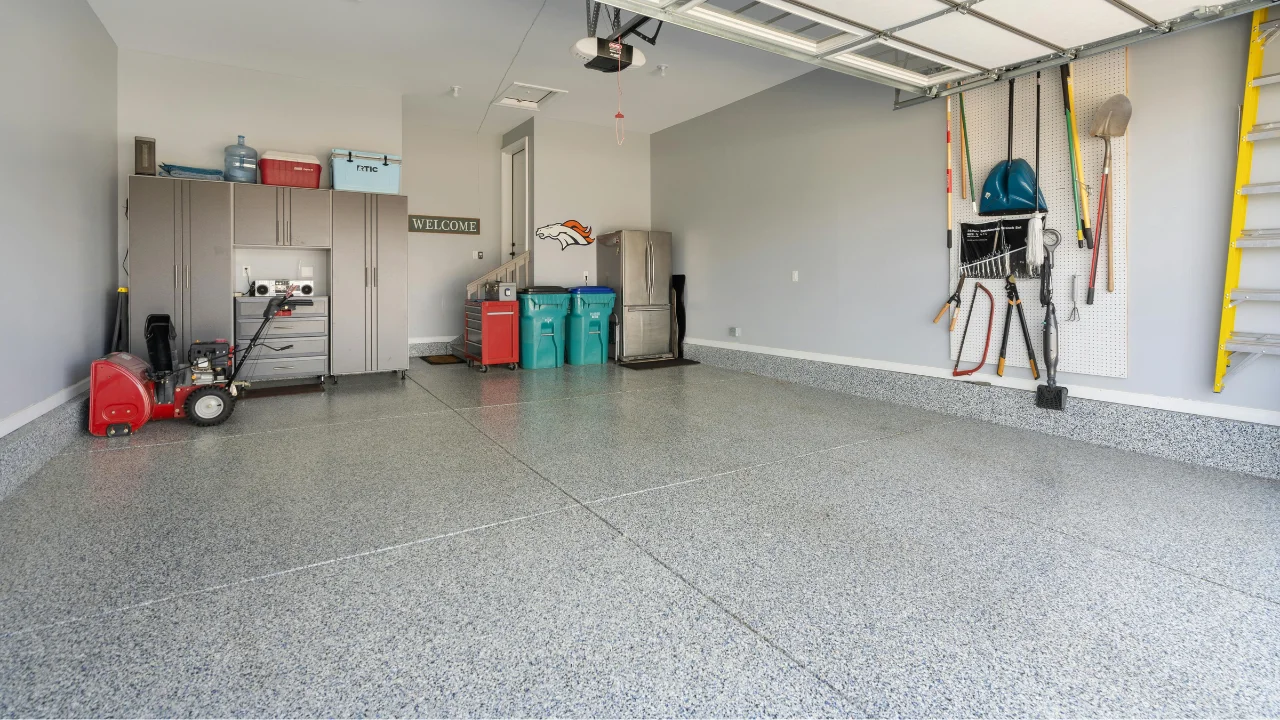
The standard residential build-up is a diamond grind for preparation, an epoxy primer, an epoxy base coat with a full broadcast of decorative vinyl flake, and a polyaspartic topcoat over the whole thing.
Premium versions add a second polyaspartic coat for extra ultraviolet stability and chemical resistance. Commercial systems use a higher-build epoxy underneath and a harder topcoat on top.
So it is not epoxy or polyaspartic. It is epoxy where epoxy is good and polyaspartic where polyaspartic is good, and a quote that names only one of them is either describing a partial system or leaving detail out.
What epoxy is good at
Epoxy is the body of the system. It bonds hard to prepared concrete, it builds film thickness, and it is comparatively economical for that build.
That thickness matters. A coating with real body fills the minor imperfections in a slab, holds the flake broadcast, and gives the floor the substance that makes it feel like a surface rather than a paint job.
Its weaknesses are equally specific. Epoxy ambers with ultraviolet exposure, which is why a garage floor with a wide south-facing door will yellow over time if epoxy is the top surface. It is also relatively rigid, and it cures slowly.
What polyaspartic is good at
Polyaspartic is the wear surface, and it is better than epoxy at almost everything a top surface has to do.
It is ultraviolet stable, so it does not amber. It is more flexible, which matters on concrete that moves seasonally. It resists chemicals, hot tire pickup and abrasion better. And it cures fast, in around twenty four hours, which is why a floor coated on a Friday can be parked on by Saturday afternoon.
Its limitations are why it is not used for the whole system. It is more expensive, it builds less film per coat, and its fast cure gives a very short working window, which makes it unforgiving to apply and a poor choice for an inexperienced crew.
The one-day coating, explained
Full polyaspartic systems, primer through topcoat, exist and get marketed hard on the promise of a single-day install. The fast cure is real, and for a household that cannot lose a garage for several days it is a genuine benefit.
Two things to check before choosing on speed alone. First, the preparation. A one-day schedule that starts with grinding is a legitimate system; one that starts with acid etching or with no preparation at all is a different product entirely. Second, the price, since polyaspartic throughout costs more than a hybrid system that puts the money where it does the most work.
The honest framing is that a one-day system buys you time, not durability. A properly built epoxy and polyaspartic floor is not the inferior option.
Where the argument actually stops mattering
Every conversation about which resin goes on top is secondary to the one about what goes underneath, because preparation is the entire job.
Coatings fail at the bond line. A thirty grit diamond grind opens the surface and exposes fresh aggregate so the primer can key into the slab mechanically. Without that, the best resin on the market is sitting on the surface film of the concrete and will come away in sheets, taking the surface layer of the slab with it.
This is why the do-it-yourself kits fail. They are a single-step rolled coating bonding to whatever the slab surface happens to be, which in most garages is sealed, contaminated and closed. Most of them let go within a few years, and the removal is worse than the original bare floor.
We covered the preparation in depth, along with road salt and hot tire pickup, in epoxy garage floor coatings in the Coulee Region. It is the post to read if you are deciding whether to have this done at all.
Moisture, which decides more than the resin does
Concrete carries moisture, and moisture moving up through a slab will push a coating off from underneath no matter what it is made of.
This is why a slab gets tested before anything goes on it, and why a basement floor is a different conversation from a garage floor. Where a slab reads high, a vapor barrier primer goes down before the system starts.
The basement case has enough of its own considerations that we treated it separately in epoxy coatings for basements and workshops, including why a satin polyaspartic topcoat reads more like a finished room than a garage.
Reading a coatings quote
- How is the slab prepared? Diamond grinding, not acid etching, and not nothing
- Is the slab moisture tested, and what happens if it reads high?
- What is the primer, and is there one?
- How many coats, and which resin is in each?
- Is the flake broadcast full or partial? A full broadcast is a different look and a different price
- What is the topcoat, and is there a second one?
- How are cracks and pits handled before coating?
- What is the return-to-service schedule for walking and for parking?
A quote that answers all eight is comparable to another quote that answers all eight. Two quotes that say "epoxy floor coating" and give a price are not comparable to anything.
What to expect afterwards
A properly prepared and correctly built system handles hot tires, oil, road salt and impact for fifteen years and up. Maintenance is unglamorous: sweep or blow off debris, damp mop with a pH-neutral cleaner, keep harsh degreasers off the topcoat, and wipe oil drips while they are fresh.
Somewhere in the ten to fifteen year range a fresh polyaspartic coat brings the floor back to like-new without touching the layers underneath, which is the same logic as recoating a wood floor rather than sanding it.
We install these systems in garages, basements, workshops and commercial floors across La Crosse, Onalaska, Holmen and the wider region. The full specification is on our epoxy and concrete coatings page, and a free in-home estimate starts with us looking at the actual slab.