
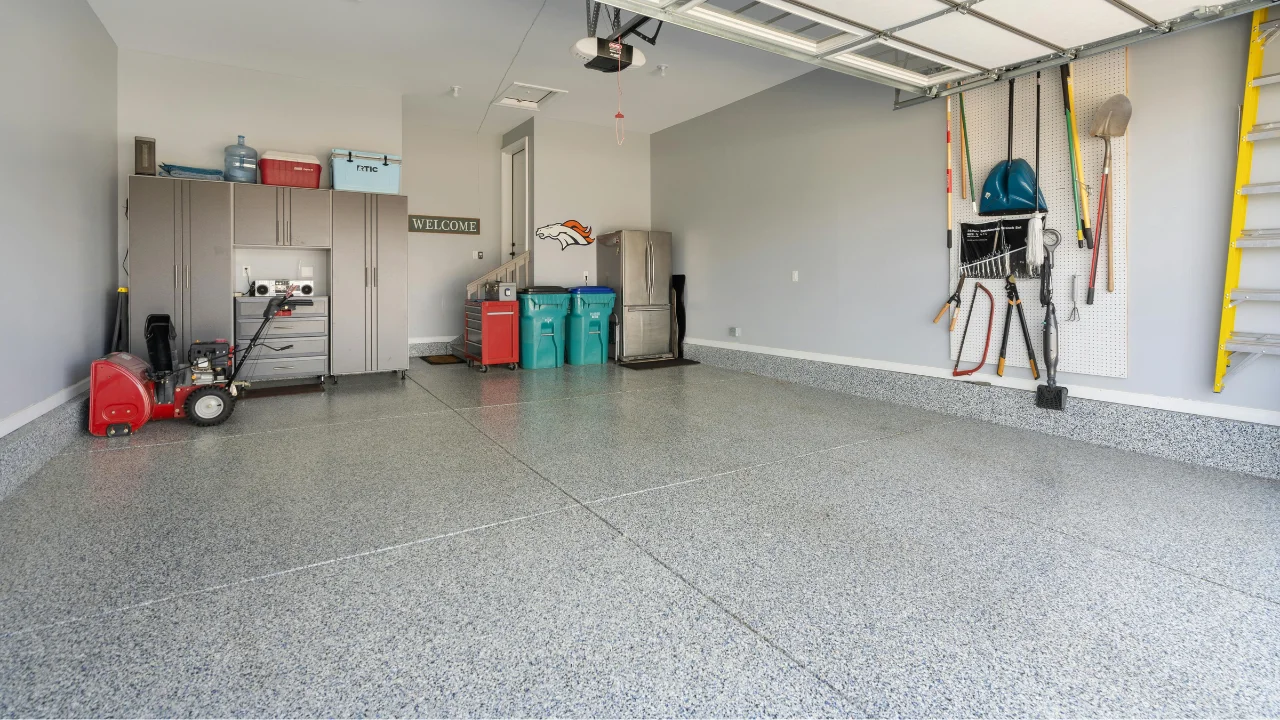
Coated garage floors have gone from a nice-to-have to something people specifically ask for, and in Wisconsin the case is stronger than most places. A sealed floor is dramatically easier to clean, it stops concrete dust, and it resists the road salt that comes in on vehicles for five months of the year.
They also fail a lot, and almost always for the same reason. Here is what actually decides whether a coating lasts.
Preparation is the entire job
If you remember one thing, make it this. A coating is only as good as its bond to the concrete underneath, and that bond is created during preparation, not during application.
Concrete in a working garage is sealed at the surface, contaminated with years of oil and road salt, and far too smooth for a coating to grip. Product applied over that looks excellent for a season and then peels off in sheets, usually starting where the tires sit. Proper preparation means mechanically grinding the concrete to open the surface so the coating can key into it, cleaning contamination out, and addressing cracks and spalling first.
This is the slow, unglamorous, expensive part of the job, and it is the entire difference between a floor that lasts and one that does not. A quote dramatically cheaper than the others is almost always cheaper right here.
Road salt is the Wisconsin argument
From roughly November through April, every vehicle that comes into your garage brings de-icing chemicals with it. Those chemicals sit on bare concrete in slush that melts off the car, soak in, and attack the slab over years. Salt damage to concrete is cumulative and not reversible.
A properly bonded coating seals the surface so none of that ever reaches the concrete. For a Wisconsin garage this is the most practical reason to coat a floor, well ahead of how it looks.
Hot tire pickup, and why kits fail
This is the specific failure mode that kills consumer-grade garage coatings. Tires get hot while driving. A hot tire parked on a coated floor softens the coating underneath it, and when the car moves the tire lifts the coating off the concrete with it, leaving bare concrete exactly where the wheel sat.
Better systems resist this by bonding harder to properly prepared concrete and curing to a tougher, more heat-tolerant film. But no product resists hot tire pickup if the surface underneath was never ground properly - which loops straight back to preparation being the whole job.
Moisture in the slab
Concrete slabs sit on ground, and ground holds water. Moisture vapor moves up through a slab continuously, and a coating applied over a slab passing significant vapor gets pushed off from below. This is worth testing rather than assuming, especially on older slabs and any garage where the grade outside slopes toward the building.
Flake or solid color
Which resins make up that system, and why the topcoat is the layer that matters most, is covered in epoxy or polyaspartic. Beyond the base coating, the visible choice is usually flake versus a solid color. Decorative flake does more than look good - it adds texture that provides grip on a floor that gets wet from snowmelt, and it hides dirt and slab imperfections far better than a solid color. In a Wisconsin garage where wet boots and melting snow are routine, that texture is genuinely useful rather than decorative.
What to expect from the process
The garage needs to be completely empty, which is usually the biggest ask. Grinding is dusty and loud. Then the coating goes down in stages with cure time between coats, and the floor has to cure before vehicles return - you can walk on it well before you can park on it, and rushing that is a good way to damage a floor you just paid for. Coatings work beyond garages too, in basements, shops and utility spaces. See our epoxy and concrete coatings page, or book a free estimate and we will look at your slab.