
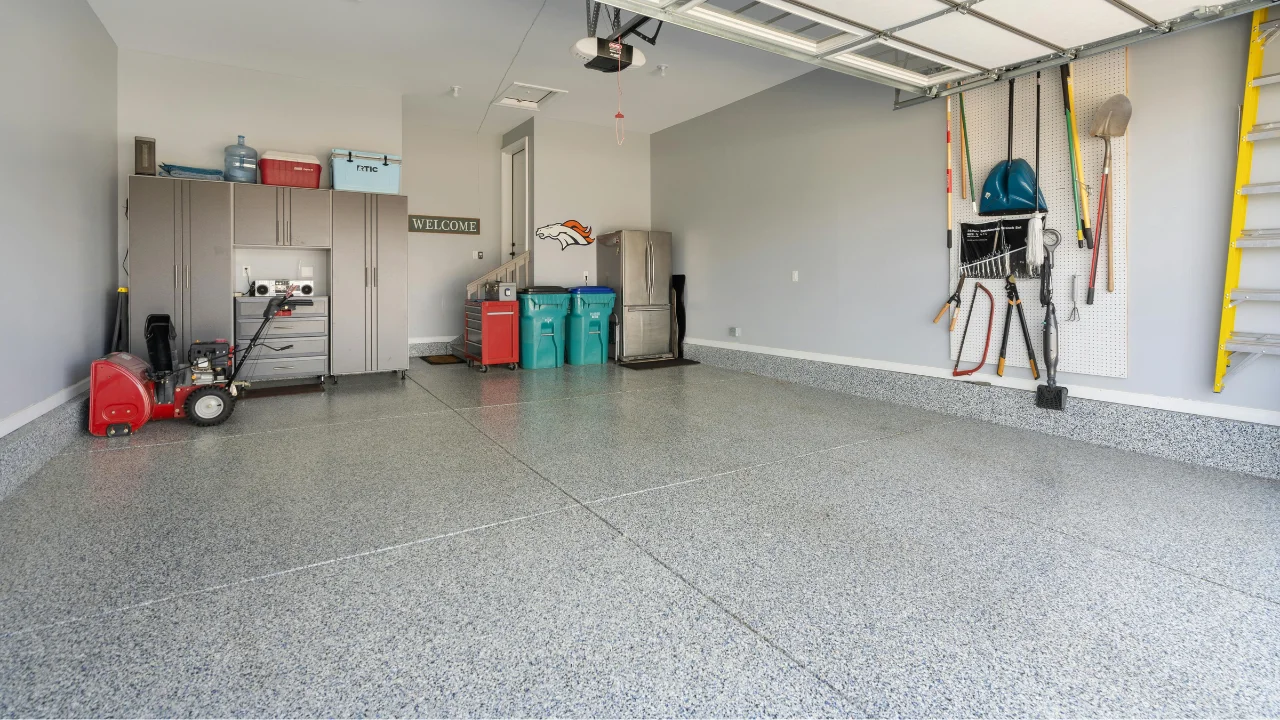
Concrete coatings get thought of as a garage product, and garages are where most of them go. But a basement, a workshop or a utility space has the same bare slab and often a better case for coating it, because those floors get used harder than people admit.
Preparation is the entire job
A coating bonds to concrete mechanically, and that bond is what everything else depends on. Concrete straight off the pour has a smooth, closed surface that coatings do not grip well, so it has to be mechanically profiled — ground or shot-blasted — to open it up.
Coating over unprepared concrete produces a floor that looks superb for a season and then peels in sheets where the traffic is heaviest. When a coating fails early, this is why, essentially every time. It is also the step most easily skipped to win a job on price, because nobody can see it once the floor is down.
Moisture, which is the basement question
Concrete passes moisture vapour upward, and a coating is a barrier. Vapour that cannot escape builds pressure underneath and pushes the coating off the slab.
In a below-grade room that is not a theoretical risk. Basements across the Coulee Region sit against ground that stays damp, and the reading varies through the year. Testing before coating is not optional, and where moisture is present there are systems designed to tolerate it — but choosing one requires knowing the number first.
What a workshop floor asks
- Chemical resistance — solvents, oils and cleaners a living space never sees.
- Impact tolerance — dropped tools and equipment set down hard.
- Slip resistance where the floor gets wet or oily.
- Easy cleaning, because a seamless floor sweeps in a way bare concrete does not.
Slip resistance is worth deciding deliberately. Broadcast aggregate builds texture into the coating and is essential in a wet or oily space; it also makes the floor slightly harder to sweep. That is a trade-off to make on purpose rather than by default.
Why coat a basement at all
Bare concrete produces dust continuously, absorbs anything spilled on it, and is cold and unpleasant underfoot. A coated slab is sealed, cleanable and considerably brighter, which matters in a room with limited natural light.
It is also the most economical way to finish a lower level that is used for storage, laundry or a workshop rather than as living space — far less than framing and finishing a floor over it.
Cure schedules
Foot traffic, vehicle traffic and full chemical resistance are three separate dates. Putting a floor back into service before it is fully cured is a common way to mark a new coating permanently, and cold slows curing — which in a Wisconsin basement matters year round, because slab temperature is not air temperature.
If you are comparing quotes that describe themselves differently, epoxy or polyaspartic explains which layer does what and the eight questions to ask. Our garage floor coatings guide covers the vehicle side, and our epoxy and concrete coatings service covers the full range.