
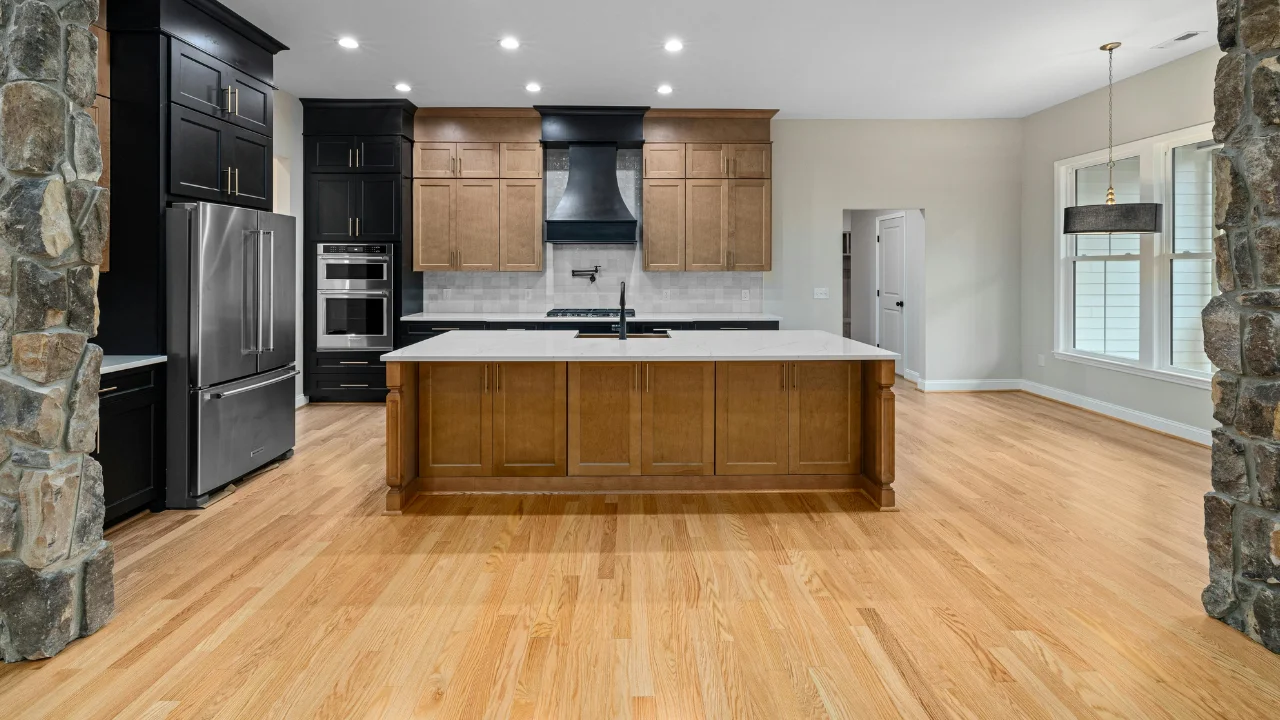
When you choose a hardwood floor, the species and the board width get most of the attention. A third choice matters just as much and gets less: whether the boards arrive already finished, or arrive raw and get sanded and finished in your home after they are installed. We install both, and the right answer depends on the room, the schedule and what you want the floor to look like in fifteen years.
What the two terms mean
Prefinished hardwood is sanded, stained and coated in a factory. The boards arrive ready to walk on, and once the last board is down the floor is done. Most prefinished floors carry a factory finish with aluminum oxide in the topcoats, cured under ultraviolet light, and the boards have a small bevel on their edges.
Site-finished hardwood arrives as raw, unfinished boards. We install them, then sand the whole floor flat, apply any stain, and build up the finish coats in the room. On our site-finished floors that means three coats of Bona Traffic HD, a waterborne finish that dries clear and ambers very little.
The look: edges and flatness
The most visible difference is at the seams. A prefinished floor has micro-beveled edges, so you see a fine line along each board. That line hides small height differences between boards, but it also catches dust and gives the floor a plank-by-plank look.
A site-finished floor is sanded after installation, so the boards meet at one level and the finish runs across the seams. The result is a flat, continuous surface with tight joints, the look of a traditional oak floor in an older Coulee Region house. If you want the floor to read as one smooth plane, site-finished is the way to get it.
Color and stain
Prefinished floors come in the colors the manufacturer makes. Many lines offer a wide range, but you choose from a sample board, and what you see is what you get.
With site-finished hardwood, the stain is mixed and applied in your room. You can test several colors on the actual boards, in your light, before choosing. That matters most when you are matching an existing floor, a stair, or built-in cabinetry, or when you want a custom blend no manufacturer offers.
Choosing a shade that suits your rooms is covered in how to choose a flooring color.
Matching or extending an existing floor
If you are adding hardwood to a room next to an existing oak floor, site-finishing usually gives the best result. The new boards are woven into the old ones, then the whole area is sanded and finished together so the color and sheen match. A prefinished board laid next to a site-finished floor almost always looks different, both in color and at the edges.
Repairing and replacing individual boards in an existing floor is covered in repairing damaged floor planks, and sanding an older floor back to bare wood in hardwood floor refinishing.
Time, dust and living in the house
This is where prefinished wins. Once a prefinished floor is installed it is ready for light use, with no sanding and no drying time between coats. For a busy household or a tight schedule, that difference is real.
Site-finishing adds three to five working days to the job for sanding and three coats of finish. During that time the rooms are off limits, and the finish needs about seven days to reach full cure, so rugs go down later and furniture goes back with care. Sanding produces fine dust and the finish has an odor while it dries, although a waterborne finish has far less than older oil-based ones.
What those days look like in practice is covered in living through a floor refinish, which applies to new site-finished floors as well.
Durability and wear
Factory finishes are hard. Aluminum oxide resists scratching well, and it is cured in conditions a house cannot match. The weak point is the bevel: the edges of each board are where wear and moisture show first, and water from a spill can sit in the grooves.
A site-applied finish seals the whole surface, seams included, in one film. It is softer than a factory finish, but it is easier to refresh. A worn site-finished floor can be lightly abraded and recoated without sanding to bare wood. Recoating a factory aluminum-oxide finish is harder, because the new coat does not bond well to it without careful preparation.
Refinishing years from now
Both types of solid hardwood can be fully sanded and refinished when the time comes. On a prefinished floor, the sander has to cut deep enough to remove the bevels if you want a flat result, which uses up more of the wear layer than a normal refinish. On engineered hardwood with a thin wear layer, that can mean the bevels stay.
How much wood a floor has to give is covered in solid vs. engineered hardwood.
Which one to choose
- Choose prefinished when you need the room back quickly, are installing over a large area at once, want a factory finish with strong scratch resistance, or are happy with a manufacturer color.
- Choose site-finished when you are matching or extending an existing floor, want a custom stain, want a flat surface with no bevels, or have a kitchen where water at the seams is a concern.
- Either works for most bedrooms, living rooms and dining rooms. The decision comes down to look and schedule.
Our hardwood flooring page covers the species and installation methods we offer, and our refinishing page covers sanding and recoating existing floors. Book a free in-home estimate and we will bring prefinished samples and talk through site-finished options in your own rooms.