
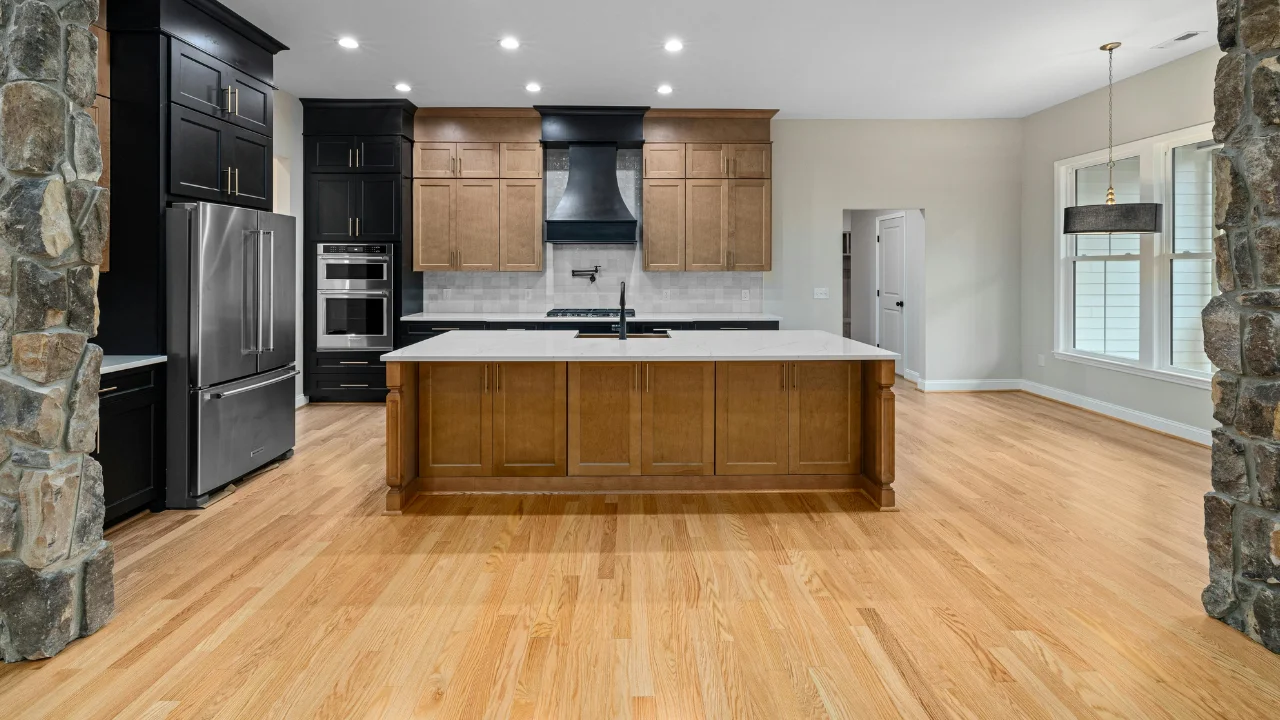
Once the decision is made to go with real wood, the next question arrives almost immediately: solid or engineered? It is often framed as good versus cheap, with engineered as the compromise. That framing is wrong in both directions. Engineered hardwood is the better floor in some rooms and the only sensible one in others, and solid hardwood is still the longest-lived floor money can buy where it fits.
The difference is entirely in how the board is built, and that decides where it can go.
How each one is built
Solid hardwood is exactly what it sounds like: each board is one piece of wood, milled with a tongue and groove, usually three quarters of an inch thick. What you see on top is the same species all the way through.
Engineered hardwood is a layer of real hardwood, the wear layer, bonded to a core of plywood or another multi-ply construction whose layers run at right angles to each other. The surface is genuine oak, hickory or walnut, and it is finished, stained and walked on exactly like solid. The core underneath is what changes its behavior.
Why the core matters: movement
Wood takes on moisture from the air and swells, then gives it up and shrinks. A solid board moves mostly across its width, which is why a solid floor shows thin gaps between boards when the heating has dried the house out in January and closes them again in a humid August.
The cross-layered core of an engineered board resists that movement, because each layer is trying to move in a different direction and they hold each other in check. An engineered floor still moves, but far less, and that stability is the whole reason it exists.
How much this matters depends on the house and the season, and in this climate the season swing is large. Flooring for Wisconsin winters covers what dry heated air does to each type of floor.
Where solid belongs
Solid hardwood is at home on a wood subfloor, above grade, in a house kept at a reasonably stable temperature and humidity. Main living areas, dining rooms, bedrooms, hallways and stairs in a home you plan to stay in are the classic case.
It is nailed down to the subfloor board by board, and it adds the most resale value of any floor we install. That is why original solid oak floors in older La Crosse and Winona houses are still in service eighty years later, and why they are worth checking for under old carpet before anything new is bought.
Where engineered is the better answer
- Over a concrete slab. Solid hardwood is nailed, and it cannot be nailed to concrete. Engineered can be glued to a slab or floated over it, which is why slab-on-grade homes and additions are engineered territory.
- Over radiant floor heat. Heat under a floor dries the wood from below, and a solid board shrinks and gaps. Engineered wood is the hardwood that works over radiant systems, within the temperature limit the manufacturer sets.
- Wide planks. The wider a solid board, the more it moves and the more likely it is to cup. Wide planks are where engineered construction earns its keep, and it is how we install wide-plank floors up to ten inches.
- Below grade. Solid hardwood does not belong in a basement. Some engineered products are rated for below-grade use over a properly prepared and moisture-tested slab, but in a basement with any moisture history we would point you to luxury vinyl plank instead.
Whatever goes over a slab, the slab gets tested for moisture first. Subfloor preparation explains what we check and why it decides whether the floor lasts.
Refinishing: the question that decides lifespan
The real measure of a hardwood floor’s life is how many times it can be sanded back to fresh wood. Every refinish removes a thin skin of the surface.
Solid hardwood has usable wood down to the tongue and groove, and can typically be sanded and refinished several times across its life. That is why it outlasts almost anything else on the market.
Engineered hardwood can only be sanded as many times as its wear layer allows, and that varies enormously between products. A thin veneer should never see a floor sander and can at most be screened and recoated. A thick wear layer can be sanded and refinished more than once. Two engineered floors that look the same on the showroom board can have very different lifespans for this reason alone.
So the one number to get in writing for an engineered floor is the wear layer thickness. Wear layer and AC rating explained covers it alongside the equivalent numbers for vinyl and laminate, and hardwood floor refinishing covers what a sanding involves.
Cost
Our installed range for hardwood is $8 to $14 per square foot, and both types sit inside it. Engineered usually costs less per square foot than solid of the same species and look, although a premium engineered floor with a thick wear layer and wide planks can cost as much as or more than a standard solid strip floor. Species, plank width, grade and pattern move the price as much as construction does. The hardwood flooring page sets out those factors.
Prefinished or site-finished
This is a separate choice from solid versus engineered, although the two get confused. Most engineered hardwood comes prefinished from the factory. Solid comes both ways.
Prefinished boards arrive with a factory-cured finish, so the floor is usable the day it is installed and there is no on-site sanding or drying. Site-finished boards are installed raw, then sanded flat, stained and coated in the house. It takes longer and the house lives around it for a few days, but the stain can be matched to existing floors or stairs and the finish forms one continuous surface across the seams.
If you are adding to an existing floor or matching new stair treads to it, site-finished is usually the answer. Living through a floor finish describes what those few days are like.
Both need acclimation
Being more stable does not excuse engineered from the process. Solid hardwood sits in the room where it will be installed for at least a week before a board goes down, and engineered follows its manufacturer’s acclimation instructions. We take moisture readings on the wood and the subfloor before installation starts, because installing wood that has not reached the conditions of the house is the most common reason a hardwood floor fails.
Warranties
Every hardwood floor we install carries our lifetime workmanship warranty, plus the manufacturer’s warranty on the wear layer, typically 25 to 50 years. Engineered hardwood also carries a structural warranty on the core, 25 years on the products we install. Read the wear layer warranty carefully on engineered floors: it is written around that same thickness figure.
A quick way to decide
- Main level on a wood subfloor, standard widths, staying long-term: solid.
- Concrete slab, radiant heat, or planks wider than standard: engineered.
- Matching or extending an existing solid floor: solid, site-finished to match.
- Basement with any moisture history: neither. Luxury vinyl plank.
- Engineered either way: ask for the wear layer thickness, in writing.
Choosing in your own house
The subfloor, the heating and the room usually decide this before taste does, and all three are things we check at the estimate. If you are still weighing wood against the alternatives, hardwood vs. LVP vs. laminate is the place to start, and if you are considering a pattern, herringbone vs. chevron floors covers the options in both. Otherwise, book a free in-home estimate and we will bring solid and engineered samples, check the subfloor and moisture, and tell you which one your rooms can take.