
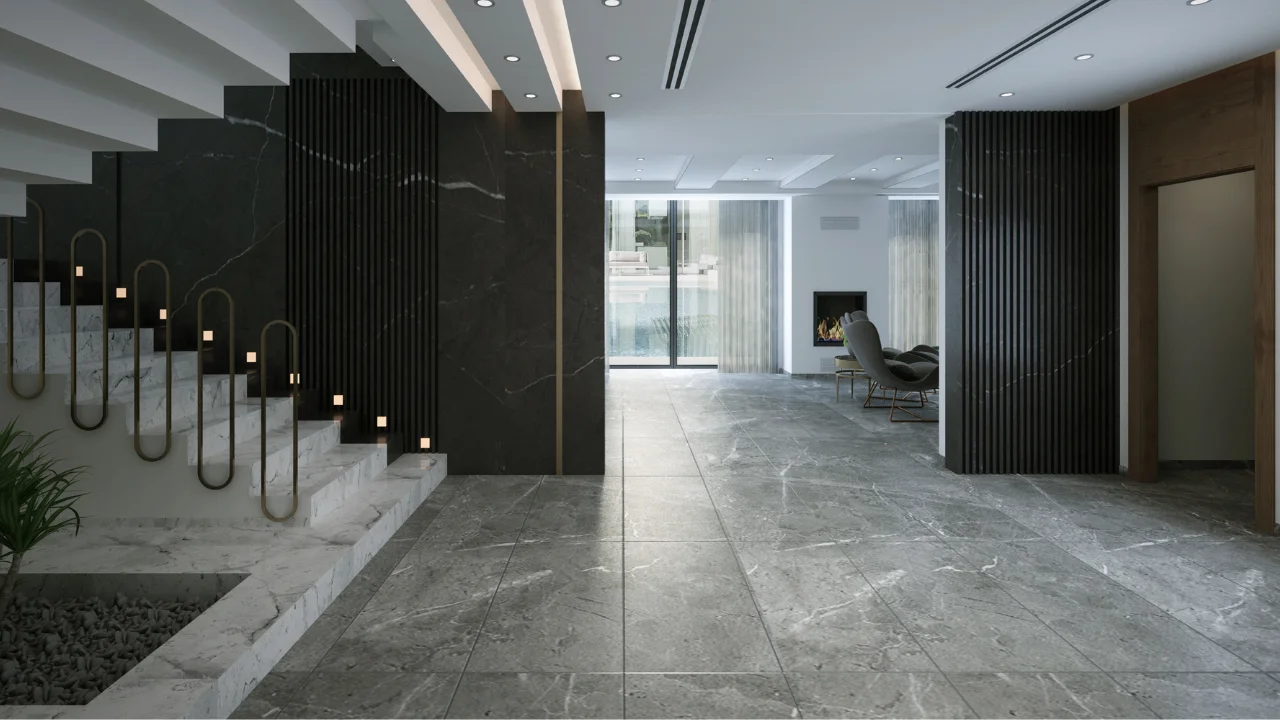
A well-installed porcelain floor is close to indestructible. The tile itself does not absorb stains, does not wear through and does not care about water. What people actually mean when they say a tile floor looks tired is almost always the grout: darkened lines in the traffic path, a shower corner that has gone gray, a joint that has cracked or started to crumble.
Grout is a cement-based material, and unless it is an epoxy grout it is porous. It takes up whatever is mopped across it. The good news is that grout is also the part of a tile floor that can be refreshed without touching the tile. Here is how to keep it clean, when to seal it, and how to tell a grout problem from a floor problem.
The routine that keeps grout clean
- Sweep or vacuum weekly. Grout lines sit slightly below the tile surface, which is exactly where grit collects, and every footstep grinds it in.
- Damp-mop with a pH-neutral tile cleaner. Neutral cleaners lift dirt without attacking the cement in the grout or the surface of natural stone.
- Change the mop water often. Most dark grout is not stained, it is dirty mop water that has been spread into the joints and left to dry there.
- Rinse if your cleaner calls for it. Cleaner residue left on the floor attracts dirt and dulls the grout faster.
For grout that has already darkened, a soft nylon grout brush with the same neutral cleaner does more than any stronger chemical. Work a small section, scrub along the joint, and wipe the dirty water up before it dries back in.
What not to put on tile and grout
- Acidic cleaners, including vinegar, on natural stone. Marble, travertine and limestone are etched by acid, and the dull marks it leaves are damage to the stone, not dirt on it.
- Harsh degreasers and repeated bleach on cement grout. They break down the grout surface and strip any sealer, which leaves the joint more porous than before.
- Wire brushes and abrasive pads. They scratch glazed tile and wear grout joints down.
- Steam on a floor whose grout is cracked or unsealed. Pushing hot moisture into a failing joint is the opposite of what it needs.
Tile and stone manufacturers publish care instructions for their products, and following them is the safest rule. Natural stone in particular varies: two stones that look similar can need different cleaners and sealers.
Does grout need sealing?
It depends on the grout. Standard cement-based grout, sanded or unsanded, is porous and benefits from a penetrating sealer. The sealer does not make it waterproof. It slows down how quickly liquid and dirt soak in, which buys time to wipe a spill before it becomes a stain.
Epoxy grout and many of the newer single-component grouts are not porous in the same way and generally do not need sealing. If you are not sure which grout is in your floor, whoever installed it will know, and it is worth asking for it in writing at the end of a tile job.
A simple test tells you whether sealed grout still has a working seal: put a few drops of water on a joint. If the water beads and sits, the sealer is doing its job. If the joint darkens as the water soaks in within a minute or two, it is time to reseal.
Sealing natural stone
Natural stone is a separate case, because the stone itself is porous, not just the joints. Marble, travertine, slate and limestone are sealed when they are installed and need resealing on a schedule. As a working guide we tell clients every 12 to 24 months, following the stone and sealer manufacturer’s spec, and the water-drop test above works on the stone as well as the grout.
If you are still choosing between porcelain and stone, the maintenance difference is a real part of the decision. Tile and stone in the Coulee Region covers where each one belongs.
Color-sealing: the refresh between regrouts
Grout that is sound but stained, uneven in color or simply dated does not have to be removed. A grout colorant, often called a color sealer, is applied into the joints and coats the grout in a uniform color while sealing it at the same time. It can return grout to its original color or change it, light to dark or the reverse.
Color-sealing only works on grout that is solid. It is a coating, and a coating over crumbling or cracked grout fails along with it. On a healthy floor, we recommend planning to regrout or color-seal every 5 to 7 years to keep the joints looking new.
When grout needs replacing
Regrouting means cutting the old grout out of the joints, cleaning them and filling them again. It is slow, careful work, because the cutting tool runs right along the tile edge, but it leaves the tile in place. It is the right answer when:
- Grout is crumbling, sandy or missing in places.
- Joints have hairline cracks that are limited to the grout and are not spreading.
- Grout in a shower or around a tub has broken down and water is getting into the joints.
- Staining is too deep for cleaning or color-sealing to correct.
In showers and tub surrounds, the corners where walls meet, and where the wall meets the tub or pan, are a different kind of joint. Those change-of-plane joints should be flexible sealant, not grout, because the surfaces move independently. Cracked grout in a shower corner is very often a corner that should have been sealed with a flexible sealant matched to the grout color.
When cracked grout is a warning sign
A single cracked joint is a maintenance issue. A pattern is different. If the cracks run in a line across several tiles, if tiles sound hollow when tapped, or if tiles themselves are cracking along the same path, the problem is underneath the tile, and new grout will crack again in the same place.
The usual causes are a subfloor that flexes, movement in the structure, or tile laid directly over a substrate that should have had a membrane between them. That is why every tile floor we install goes over Schluter DITRA uncoupling membrane: it lets the floor underneath move slightly without passing that movement to the tile and grout. Subfloor prep: the part of the job you never see explains why the layer underneath decides how long a tile floor lasts.
Showers: the joints that matter most
Grout is not a waterproofing layer, and a shower that relies on grout to keep water out of the wall is relying on the wrong thing. In a properly built shower, the waterproofing is a membrane behind the tile, and the grout is there to fill the joints. Keeping shower grout sealed and in good repair still matters, because broken joints hold water and mildew, but if there is any sign of water damage behind the tile, the fix is more than grout.
Our showers are built on the Schluter KERDI waterproofing system for that reason. If a tiled shower is part of a larger bathroom project, the order of work in a bathroom remodel covers where the waterproofing fits in.
If you are planning a tile floor
Grout choice is a maintenance decision as much as a color decision. Mid-tone grout hides everyday dirt far better than bright white, epoxy grout costs more but resists stains and does not need sealing, and larger-format tile means fewer grout lines to look after. We talk through all three at the estimate. Our tile and stone page covers the materials and the system we install underneath, every install carries our lifetime workmanship warranty, and we touch up any grout joint that needs it in the first 30 days. Book a free in-home estimate to get started.