
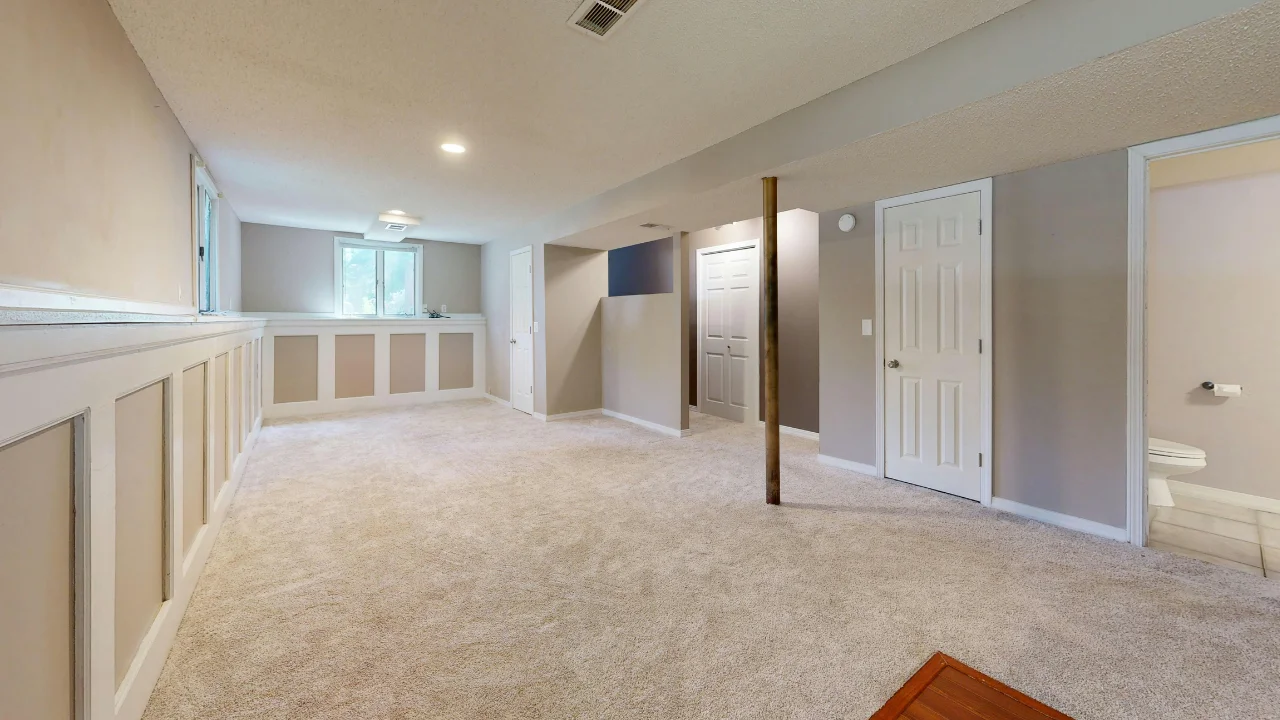
Carpet has a reputation as the easy floor, and in one sense it is: no subfloor leveling to speak of, no expansion gaps, no transitions to agonize over, done in a day. In another sense it is the floor we see installed wrong more than any other, because the mistakes do not show on the day. They show eighteen months later as a ripple across the living room, a seam that has peeked, or a stair that has loosened.
This is what a proper carpet installation in La Crosse involves, so you know what is being done under the carpet you chose. Choosing the carpet itself, the fiber, twist, density and pad, is covered in choosing carpet. This is the other half.
Stretch-in over pad, or glue-down
Residential carpet is almost always installed stretch-in: a separate pad is laid over the subfloor, tack strip is nailed around the perimeter with the pins angled toward the wall, and the carpet is stretched over the pad and hooked onto the pins. The carpet is not fastened to the floor anywhere except the edges. Its tension is what holds it flat.
Glue-down, where the carpet is adhered directly to the subfloor with or without an attached cushion, is a commercial method. It suits offices, high-traffic corridors and rolling chairs, and it is what our commercial flooring work uses where carpet is specified. In a house, stretch-in over a good pad is softer, quieter, warmer and replaceable.
The power stretcher, and why it is not optional
This is the whole difference between a carpet that lies flat for its life and one that ripples.
A knee kicker is the small tool with a padded end the installer bumps with the knee. It positions carpet and hooks it onto the tack strip in tight spots. It cannot stretch a room. A power stretcher is a long pole with a head that braces against the opposite wall and levers the carpet tight across the full width of the room, to the tension the manufacturer specifies. Every room gets stretched with it, in both directions.
Knee-kicked carpet looks fine on day one and ripples in eighteen months, because the tension was never there. A ripple can sometimes be re-stretched later, but it is a service call that should never have been needed. If an installer arrives without a power stretcher, that is the thing to ask about.
Pad
The pad is half the purchase and the half people skip. It decides how the carpet feels, how it wears, and how the seams hold. The manufacturer specifies a pad thickness and density for each carpet, and a pad that is too thick or too soft lets the carpet flex over it and breaks the backing down early. Our carpet installation page covers the pads we use, and the choosing carpet guide explains how to match one to the carpet.
Seams: where they go and how they are made
Carpet comes on a roll of a fixed width, and most rooms are wider than that, so most rooms have a seam. Where it goes is planned before the carpet is cut.
- Away from the main light source. A seam runs with the light, not across it, so the shadow does not fall along it.
- Away from the main traffic path and out of doorways where possible, because seams take wear.
- With the pile direction matched on both sides. Carpet has a nap, and two pieces laid with the nap opposed look like two different colors.
- Patterned carpet is seamed on the pattern repeat, which adds waste and adds care.
The seam itself is made with heat-bond seaming tape under the joint and a seaming iron that melts the adhesive, then the edges are pressed together and rolled. Done well on a plush or a well-made loop, a seam is very hard to find. Done badly, or on a carpet whose construction shows seams, it is the first thing you see. We tell you at the estimate if the carpet you have chosen is one that shows seams, and where the seam in your room will fall.
Seams are also why carpet is ordered with waste. The layout that puts seams in the right places uses more carpet than the square footage of the room, and how much flooring you actually need explains the allowance.
Stairs
Stairs are the hardest carpet in the house to install and the fastest to wear, and there are two ways to wrap them.
Waterfall is the carpet run straight over the nose of each tread and down the riser in one piece, without being tucked under the nosing. It is faster and uses less labor. Hollywood, or cap and band, wraps the carpet tight around the nosing and fastens it under the lip of the tread, so the profile of each step shows through. It looks more tailored and it is what we recommend on an open staircase or one with a hardwood nosing. Both are stretched tread by tread with a stair tool, and neither should ever be loose enough to slide underfoot.
Runners on a hardwood stair, leaving wood showing at the edges, are a third option and a finish carpentry conversation as much as a carpet one. If the plan is to take the stair carpet off entirely, carpeted stairs to hardwood covers what that involves.
Install day, in order
- Furniture is moved out or to the center as agreed at the estimate. We tell you in advance what needs to be off the floor.
- Old carpet and pad come up, staples are pulled, and the old tack strip is checked. Reusable strip stays; damaged strip is replaced.
- The subfloor is swept, and any squeaks, proud nails or soft spots found under the old carpet are fixed before the pad goes down.
- New pad is laid, seamed and stapled or taped, and trimmed to the tack strip.
- Carpet is cut to the layout, seams are made, the carpet is power-stretched and hooked, and the edges are trimmed and tucked.
- Transitions at doorways to hard floors are set, and stairs are done last.
- Vacuum, walk-through, and the old carpet goes out with us.
Most whole-house carpet installs in the region are one to two days. The same-day rule applies here as everywhere: a floor that goes in with a squeak or a soft spot left underneath it is a floor that will be lifted again.
Afterward
New carpet sheds loose fiber for the first few weeks, which vacuums up and is normal. Furniture goes back the same day. Seams and stretched edges settle in over the first month. Vacuum regularly, use entry mats at exterior doors, and have the carpet hot-water extracted every twelve to eighteen months, which adds years to its life and keeps most manufacturer warranties valid.
Where carpet belongs
Bedrooms, basements, family rooms and stairs are where carpet still wins in a Wisconsin house: it is the warmest floor and the quietest. Whether it is the right choice in a home with dogs and kids is a fair question, covered in best flooring for pets and kids, and the answer depends more on fiber than on the fact of carpet.
Getting it done properly
We stock more than two hundred carpet styles at our Onalaska showroom and bring samples to every in-home estimate, and our crews power-stretch every room, plan every seam and wrap every stair the way this article describes. We install carpet across La Crosse, Onalaska, Holmen and the wider Coulee Region, with financing available for whole-house projects. A free in-home estimate includes the measure, the seam plan and a fixed, itemized price.