
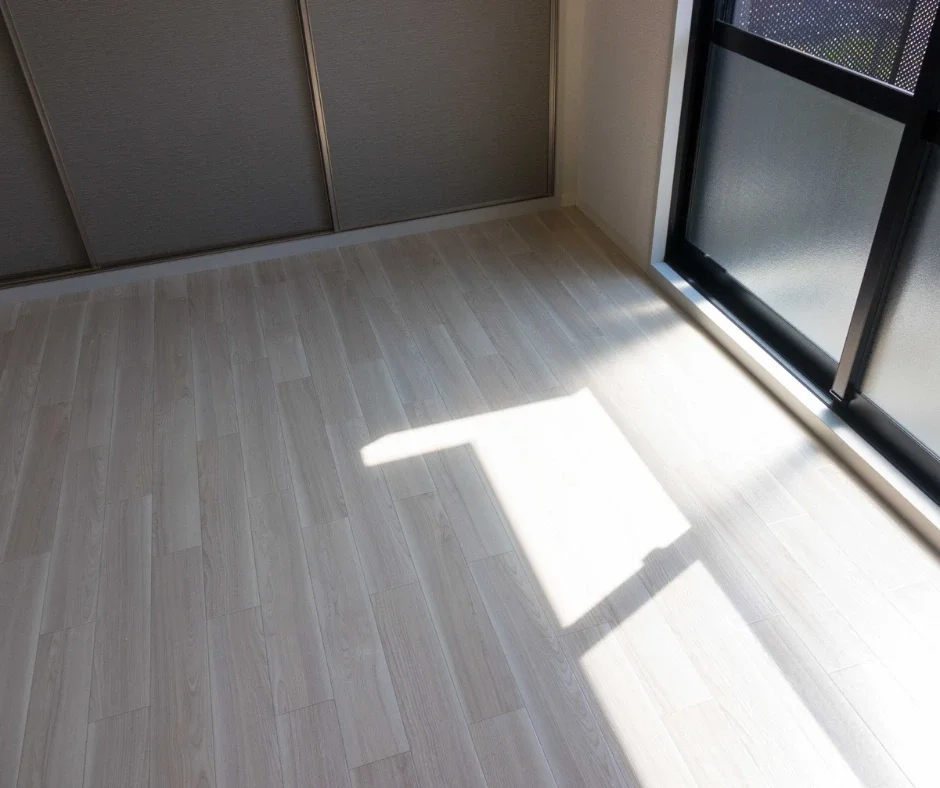
It is one of the most common questions we get about laminate, and the packaging does not make it easier. Boxes say water-resistant, some say splash-proof, and a few use the word waterproof with a time limit attached. Meanwhile, plenty of homeowners remember laminate from the early 2000s that swelled at the seams the first time the dishwasher leaked.
The short answer is that modern laminate is water-resistant, not waterproof. That is a meaningful improvement, and it covers most of what happens in a bedroom, a living room or an everyday kitchen. It does not cover standing water, and that is the line to plan around.
How laminate is built
A laminate plank is made of layers: a clear, hard wear layer on top, a printed wood image beneath it, a core of high-density fiberboard (HDF), and a backing layer underneath. The wear layer and the image are what you see and walk on, and they handle water well. The core is the part that matters for this question.
HDF is wood fiber pressed together under heat and pressure. It is dense, stable and strong, which is why laminate feels solid underfoot. It is also still wood fiber, and when water reaches it, it swells. Once an HDF core has swollen, it does not shrink back flat. The edges stay raised, a defect called peaking, and the plank has to be replaced.
What water-resistant means in practice
Since the core is the vulnerable part, modern laminate protects the route water would use to reach it: the joints. Good water-resistant laminate has tight click-lock joints and edges that are treated or sealed so liquid sitting on the surface does not wick down into the core. The 12mm AC4-rated laminate we install as standard has water-resistant edge sealing, and many manufacturers back theirs with a warranty against swelling at the seams.
That protection is real, and it is time-limited. Manufacturers that rate their laminate for surface water state how long it can sit, and the fine print usually ties the rating to the floor being installed and maintained to their instructions. A spill wiped up promptly is covered. A slow leak under a sink that nobody notices for a week is not.
The rule we give clients is simple: wipe spills when they happen. Water resistance buys you time to notice. It does not mean the water can stay.
Where laminate works
- Bedrooms, dens and home offices, where water is rare.
- Living rooms and family rooms, including houses with kids and pets.
- Second floors and hallways.
- Kitchens, with care. Laminate handles everyday spills and is a reasonable choice in a household that wipes up promptly. If the kitchen has a history of leaks, or the dishwasher and sink are the main worry, LVP is the safer floor.
- Rental units in dry rooms, where the AC rating matters more than the water rating.
Where it does not
- Full bathrooms. Shower and tub splash, wet towels and the occasional overflow are standing water by any definition.
- Mudrooms and entries where snow melts off boots in puddles all winter.
- Laundry rooms, where a failed washer hose puts a lot of water on the floor quickly.
- Basements with any moisture concern, and concrete slabs with significant moisture, where the issue is vapor coming up from below rather than spills from above.
For those rooms we point clients toward LVP or tile. Waterproof flooring for Wisconsin basements and mudrooms goes through those options room by room.
Laminate vs. LVP when water is the question
Rigid-core luxury vinyl plank has a core that does not absorb water, so the plank itself is waterproof. That is why it wins in any wet room. It is worth being precise, though: a waterproof plank is not a waterproof floor. The seams between LVP planks are not watertight, and water that sits long enough works through them to the subfloor below. The difference is that LVP planks survive the event, while swollen laminate has to come out.
Laminate has its own advantages in dry rooms. It reads as wood at conversational distance, 12mm laminate feels more substantial and sounds quieter underfoot than most LVP, and the top layer holds up to claws and chair legs. It is also typically the lower installed cost of the two: we publish laminate at $4 to $7 per square foot installed and LVP at $5 to $9.
If you are weighing the two, or wondering whether hardwood belongs in the mix, hardwood vs. LVP vs. laminate compares all three room by room.
Installation affects water resistance too
A laminate floor’s water resistance depends partly on how it goes down. Joints that are not fully engaged leave a gap at the seam, and gaps are where water gets in. A subfloor that is out of flat lets planks flex at the joints every time someone walks across them, which loosens them over time. And laminate is a floating floor that needs its expansion gap at every wall and fixed object: pinned without one, it buckles in the first humid summer.
We check subfloor flatness at every estimate, because laminate needs leveling anywhere it is more than 3/16 inch out of plane over an 8-foot span. Subfloor prep explains what that involves and why it is quoted up front.
Living with a laminate floor
- Sweep weekly and damp-mop with a laminate-safe cleaner. Damp means a well-wrung mop or a spray mop, never a wet one.
- No steam mops and no wax. Steam forces hot moisture into the joints, which is exactly what the edge sealing is trying to keep out.
- Mats at exterior doors, with backings that are safe for the floor rather than rubber.
- Check under sinks and behind the dishwasher and refrigerator occasionally. A slow leak caught early is a towel; caught late, it is a row of planks.
- Keep a box of leftover planks. If a few planks are ever damaged, matching them is much easier from your own stock.
Choosing the right floor for the room
Whether laminate is right for a room is usually clear once we see it. Our laminate flooring page covers the products and ratings we install, and our luxury vinyl plank page covers the waterproof alternative. Every install carries our lifetime workmanship warranty. Book a free in-home estimate and we will bring samples of both so you can compare them in your own light.